
How to Import Leather Bags from India to the UK: Complete Guide for Brands & Bulk Buyers
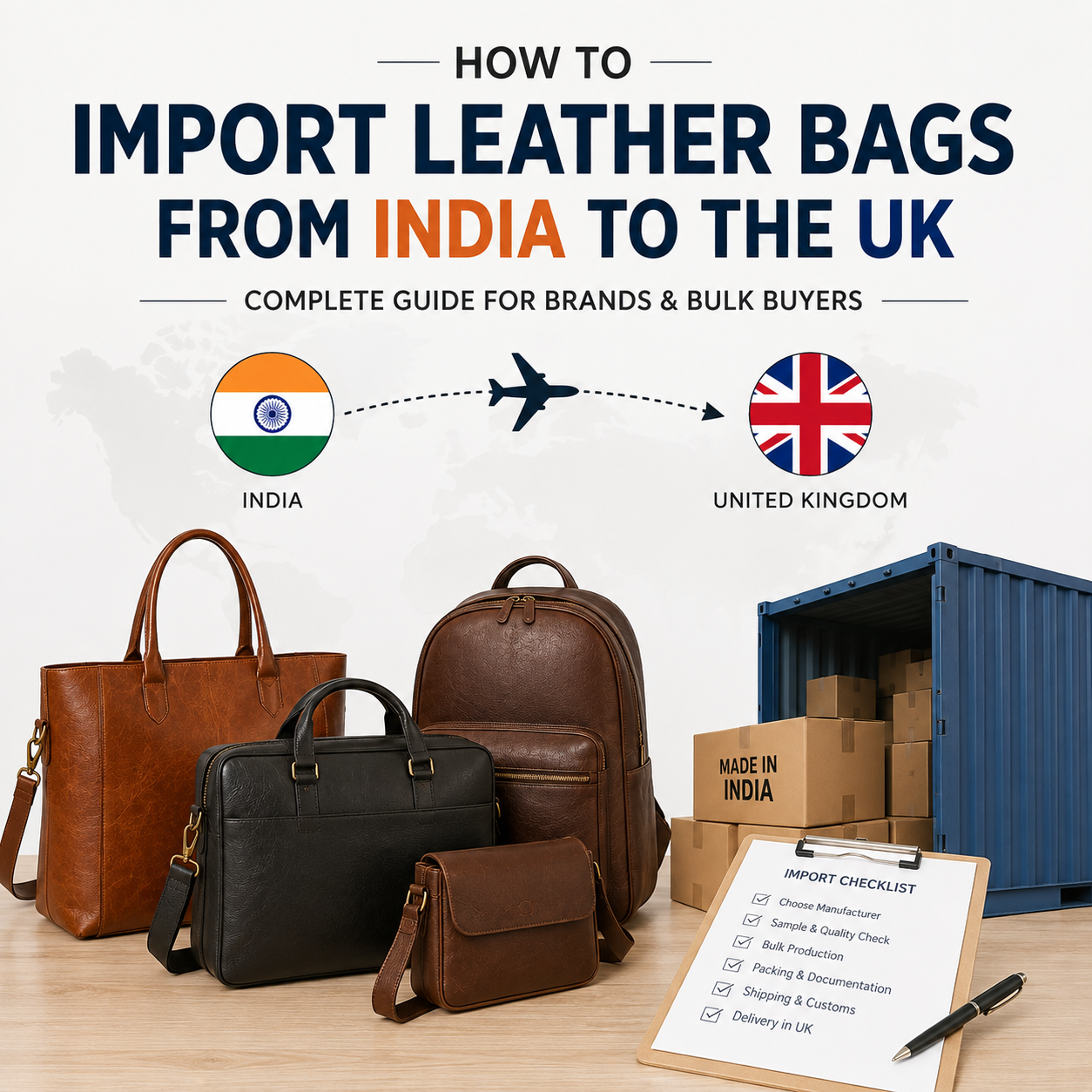
Importing leather bags from India to the UK can be a practical sourcing strategy for fashion brands, retailers, wholesalers, importers, distributors, and private label businesses looking to develop products at scale. India has an established leather goods manufacturing industry, skilled craftsmanship, and a broad supplier ecosystem that supports custom product development and bulk production.
For UK businesses, however, successful sourcing involves more than finding a supplier and placing an order. You need to select the right leather bag manufacturer in India, develop and approve samples, establish quality requirements, understand branding and packaging, plan international shipping, and make sure the import process is handled correctly.
This guide explains how to import leather bags from India to the UK, with a focus on B2B buyers looking for OEM, private label, custom, and bulk manufacturing solutions.
At Saga Lifestyle, we support international businesses with leather bag manufacturing from our manufacturing facility near Mumbai, including product development, sampling, custom branding, bulk production, quality control, packaging, and export support.
Why UK Businesses Import Leather Bags from India
India is an established manufacturing destination for leather goods, making it attractive for businesses that need customized products and scalable production.
UK businesses can work with Indian manufacturers to develop:
- Private label leather bags
- OEM leather bags
- Custom clutch bags
- Leather tote bags
- Leather backpacks
- Leather laptop bags
- Leather sling bags
- Leather hobo bags
- Leather duffle bags
- Leather travel bags
- Office and business bags
- Corporate and promotional bags
For a growing brand, importing directly from a manufacturer can provide greater control over product specifications, branding, packaging, and production than buying generic products through a traditional wholesale channel.
How to Import Leather Bags from India to the UK
The process can be divided into several important stages:
Product Planning → Manufacturer Selection → Design & Sampling → Quality Approval → Bulk Production → Inspection → Export Documentation → Shipping → UK Customs Clearance → Delivery
Understanding each stage before placing an order can reduce delays, quality issues, and unexpected costs.
Step 1: Define Your Leather Bag Requirements
Before contacting a manufacturer, establish exactly what you want to import.
Your product specification should ideally include:
- Bag type
- Dimensions
- Material
- Leather finish
- Colour
- Hardware
- Lining
- Number of compartments
- Pocket configuration
- Logo placement
- Packaging
- Quantity
- Target market
For example, if you are launching a UK fashion collection, you may require a combination of leather handbags, tote bags, crossbody bags, backpacks, and laptop bags rather than a single product.
Clear specifications make it easier for a manufacturer to understand your requirements and prepare an accurate quotation.
Step 2: Find a Reliable Leather Bag Manufacturer in India
Choosing the right manufacturing partner is one of the most important parts of the sourcing process.
Don’t select a supplier only because they offer the lowest price. Evaluate their actual manufacturing capabilities, product quality, communication, customization options, and ability to handle repeat bulk orders.
Look for a manufacturer that offers:
- OEM manufacturing
- Private label manufacturing
- Custom product development
- Prototype sampling
- Bulk production
- Quality inspection
- Custom branding
- Packaging solutions
- International export support
If you are specifically looking for a Leather Bag Manufacturer For UK, investigate whether the company has genuine manufacturing capabilities and can support your product category rather than simply acting as a trading intermediary.
Step 3: Choose the Right Product and Material
The material you select will affect the product’s appearance, durability, positioning, and manufacturing cost.
Depending on your brand requirements, manufacturers may work with:
Genuine Leather
Suitable for premium fashion, lifestyle, travel, business, and luxury-oriented products.
Full-Grain Leather
Often selected for premium products where natural grain and durability are important.
Top-Grain Leather
A versatile option for brands seeking a refined leather appearance.
Vegan Leather
Suitable for brands developing animal-free product collections.
PU and Faux Leather
Can provide additional flexibility for products positioned at different price points.
The right choice depends on your target customer, product positioning, design, and business model.
Step 4: Develop Your Product Samples
Never rely only on product photographs when sourcing leather bags for your brand.
A physical prototype or approved sample allows you to evaluate the actual product before committing to bulk production.
Check:
- Leather quality
- Colour
- Dimensions
- Stitching
- Hardware
- Zippers
- Lining
- Handles
- Shoulder straps
- Logo placement
- Functionality
- Overall finishing
If something needs to be changed, communicate the revisions before approving the final sample.
For private label businesses, the approved sample should become the production reference so the bulk order remains consistent with the agreed specifications.
Step 5: Customize Your Brand
One of the biggest advantages of working directly with a Private Label Leather Bag Manufacturer is the ability to create products under your own brand.
Branding options can include:
- Logo embossing
- Debossed logos
- Metal logo plates
- Custom zipper pullers
- Woven labels
- Printed labels
- Hang tags
- Custom lining
- Dust bags
- Gift boxes
- Branded cartons
These details can transform a standard leather bag into a complete branded product.
For UK fashion brands, consistent branding across the bag, packaging, and accessories can help create a stronger customer experience.
Step 6: Confirm Bulk Production Requirements
Once the sample has been approved, discuss the bulk production requirements with your manufacturer.
Important details include:
- Final quantity
- Colour breakdown
- Material specifications
- Packaging requirements
- Branding requirements
- Production schedule
- Inspection requirements
- Shipping method
- Delivery destination
If you’re working with a bulk leather bag manufacturer, make sure the supplier can maintain the same specifications throughout the entire production run.
This is especially important when you plan to place repeat orders.
Step 7: Quality Control Before Export
Quality control should not be treated as an optional step.
A professional manufacturing process should include checks throughout production and before shipment.
Important inspection points include:
Material Quality
Check whether the leather or selected material matches the approved specification.
Stitching
Look for consistent stitching, secure seams, and clean finishing.
Dimensions
Verify that products match the approved measurements.
Hardware
Check zippers, buckles, rings, clasps, magnetic closures, and other components.
Branding
Confirm that logos, labels, and branding elements are correctly positioned.
Final Finishing
Inspect edges, surface appearance, cleanliness, and overall presentation.
Packaging
Ensure each product is packed according to the agreed requirements.
A consistent quality-control process helps protect your brand from defective products and unnecessary returns.
Step 8: Prepare Export Documentation
International B2B shipments require appropriate commercial and customs documentation.
Depending on the shipment and arrangements, documentation can include:
- Commercial invoice
- Packing list
- Bill of lading or airway bill
- Export documentation
- Product information
- Origin information
- Customs information
India’s DGFT guidance identifies documents such as the commercial invoice/packing list and transport document as part of export/import documentation, and an Importer Exporter Code (IEC) is required for entities undertaking export/import activities in India.
Your manufacturer, freight forwarder, customs broker, or logistics provider should clarify which documents are required for your particular shipment.
Step 9: Understand UK Import Requirements
UK businesses importing commercial goods from India need to prepare for the UK customs process.
For Great Britain, businesses generally need an EORI number when importing goods from outside the UK. HMRC states that an EORI is used for customs activities and import declarations.
You’ll also need to determine the correct commodity code for the products being imported. Commodity codes are used to identify goods and help determine applicable Customs Duty and import VAT.
Leather bags and similar products can fall under Chapter 42 classifications, but the exact commodity code depends on the product’s construction, outer material, and type. UK guidance specifically covers handbags, travel goods, backpacks, shopping bags, and similar containers under the relevant leather-goods classifications.
Important: Don’t assume one commodity code applies to every bag you manufacture. Confirm the correct classification for each product with the UK Trade Tariff or your customs professional.
Step 10: Calculate Your Total Landed Cost
The manufacturer’s product price is only one part of your actual import cost.
A UK buyer should consider:
Product Cost + Packaging + Inland Transport + Freight + Insurance + Customs Charges + Import VAT + Clearance/Agent Fees + Delivery
Your final landed cost depends on the specific products, commodity codes, shipment terms, logistics arrangements, and applicable UK taxes and duties.
Don’t base your purchasing decision only on the factory quotation.
A manufacturer offering a slightly higher unit price may provide better overall value if they deliver consistent quality, professional packaging, fewer defects, and reliable production schedules.
What About Customs Duty When Importing Leather Bags from India?
This is an area where UK buyers should be particularly careful.
The applicable duty depends on the correct commodity classification and the rules applicable to the shipment.
The UK government explains that commodity codes determine the applicable customs treatment, including Customs Duty and import VAT.
Also, UK tariff preferences can depend on the relevant trade arrangement, product classification, and rules of origin.
For leather goods specifically, the UK has published information concerning the treatment of goods from India under the Developing Countries Trading Scheme, including graduation measures affecting Chapter 42 goods from 2026.
Therefore, UK importers should check the current UK tariff treatment for their exact commodity code before placing an order rather than relying on an old duty rate found online.
Choosing the Right Shipping Method from India to the UK
Your shipping method depends on order size, delivery requirements, and budget.
Sea Freight
Generally suitable for larger commercial shipments and bulk orders where transit time is less critical.
Air Freight
Useful for urgent shipments, samples, smaller consignments, or time-sensitive product launches.
Courier
Often suitable for prototypes, samples, documents, and smaller shipments.
For large B2B orders, your manufacturer or freight partner can help evaluate the most suitable shipping arrangement.
Incoterms and Delivery Responsibilities
Before confirming an order, make sure both parties understand who is responsible for:
- Transportation
- Export clearance
- Freight
- Insurance
- Import clearance
- Customs charges
- UK delivery
Your commercial agreement should clearly state the agreed shipping terms.
This avoids misunderstandings when the shipment reaches the UK.
Leather Bag Products UK Businesses Can Import from India
A major advantage of working with a full-service manufacturer is the ability to source multiple product categories from one manufacturing partner.
Leather Handbags
Custom handbags for fashion brands, boutiques, retailers, and private label collections.
Leather Tote Bags
Ideal for everyday fashion, shopping, lifestyle, corporate, and retail collections.
Leather Sling Bags
Compact crossbody and sling bag designs for modern fashion and lifestyle brands.
Leather Backpacks
Suitable for fashion, work, travel, education, and everyday use.
Leather Laptop Bags
Professional products for corporate, office, business, and executive markets.
Leather Messenger Bags
A versatile category for professional and casual collections.
Leather Duffle Bags
Suitable for travel, gym, weekend, and premium lifestyle products.
Leather Travel Bags
Designed for brands targeting travel Bag and premium luggage customers.
Leather Office Bags
Professional bags for executives, employees, business users, and corporate buyers.
Corporate & Promotional Bags
Custom branded bags for corporate gifting, events, promotional campaigns, institutions, and business programs.
Custom Leather Bags
If your product doesn’t fit a standard category, OEM manufacturing allows you to develop a completely customized design based on your specifications.
OEM vs Private Label: Which Is Right for Your UK Business?
Both models can work well, but they serve different business requirements.
OEM Manufacturing | Private Label Manufacturing |
Based on your own design | Based on an existing or adaptable design |
High customization | Faster product development |
Suitable for unique collections | Suitable for faster brand launches |
Greater development involvement | More streamlined process |
Ideal for established brands | Ideal for startups and growing brands |
If you already have a product concept, technical drawing, or physical sample, OEM leather bag manufacturing may be the right option.
If you want to launch a branded collection more quickly, private label leather bag manufacturing can be a practical alternative.
How UK Buyers Can Reduce Import Problems
A successful India-to-UK sourcing relationship starts with preparation.
Approve Samples Before Bulk Production
Never rush directly into a large production order without validating the product.
Create Detailed Specifications
Document dimensions, materials, colours, hardware, branding, packaging, and quality requirements.
Confirm Shipping Terms
Make sure both parties understand responsibilities for freight, customs, insurance, and delivery.
Verify Commodity Classification
Use the correct UK commodity code for the exact product.
Work With Experienced Logistics Partners
A customs broker or freight forwarder can help manage the import process.
Maintain Production Records
Keep approved samples, specifications, invoices, packing lists, and other relevant documents for your business records.
Why Choose Saga Lifestyle for Leather Bag Manufacturing from India?
Saga Lifestyle works with B2B buyers seeking a reliable manufacturing partner for leather and synthetic bag production from India.
Our manufacturing services include:
- OEM Leather Bag Manufacturing
- Private Label Leather Bag Manufacturing
- Custom Leather Bag Manufacturing
- Product Development
- Prototype Sampling
- Bulk Production
- Logo Embossing
- Custom Branding
- Packaging Solutions
- Quality Control
- Export Support
We manufacture a broad range of products, including handbags, tote bags, sling bags, backpacks, laptop bags, messenger bags, duffle bags, travel bags, office bags, corporate bags, and custom-designed leather products.
For UK brands, retailers, wholesalers, importers, and distributors, our objective is to provide a complete manufacturing relationship from the first product concept through sampling, bulk production, quality control, packaging, and export.
Frequently Asked Questions
Can UK businesses import leather bags directly from India?
Yes. UK businesses can source commercial leather bags from Indian manufacturers, subject to applicable customs, tax, product, and import requirements.
What do I need to import leather bags into the UK?
For commercial imports into Great Britain, businesses generally need an EORI number and must make the appropriate customs declaration. You also need the correct commodity code and should determine applicable duty and import VAT.
How do I find a reliable leather bag manufacturer in India?
Check manufacturing experience, product capabilities, sampling procedures, quality control, production capacity, branding options, export experience, and communication. Request samples before placing significant bulk orders.
Can I import private label leather bags from India?
Yes. UK brands can work with private label manufacturers to develop bags featuring their own logo, labels, packaging, hardware, and other branding elements.
Can Saga Lifestyle manufacture custom leather bags?
Yes. Saga Lifestyle provides OEM and custom manufacturing solutions based on product designs, reference samples, specifications, and branding requirements.
What types of leather bags can I import from India?
UK buyers can source handbags, tote bags, sling bags, backpacks, laptop bags, messenger bags, duffle bags, travel bags, office bags, corporate bags, and other custom bag designs.
Can I order samples before placing a bulk order?
Yes. Sample development is an important part of the product-development process and allows buyers to evaluate the product before bulk manufacturing.
Final Thoughts: Import Leather Bags from India to UK With the Right Manufacturing Partner
Learning how to import leather bags from India to UK is only the first step. For a successful B2B sourcing relationship, you need the right manufacturer, clear product specifications, approved samples, reliable quality control, appropriate documentation, and a well-planned logistics process.
India offers UK businesses access to experienced leather goods manufacturers capable of producing everything from handbags and tote bags to backpacks, laptop bags, sling bags, duffle bags, travel bags, and completely custom products.
For brands building their own collections, OEM and private label manufacturing can provide greater control over design, branding, packaging, and product development.
At Saga Lifestyle, we help international businesses turn product concepts into commercially ready bags through OEM manufacturing, private label production, custom development, bulk manufacturing, branding, quality control, and export support.
Recent Post
-
 23 Sep 2026How Italian Brands Can Launch a Private Label Leather Bag Collection with an Indian Manufacturer
 -
 18 Sep 2026From Design to Delivery: How UK Brands Can Manufacture Private Label Bags in Bulk
 -
 16 Sep 2026How UK Retailers Can Source Custom Leather Bags in Bulk from India
 -
 25 Aug 2026Private Label Leather Bag Manufacturer in India: A Guide for Global Buyers
 -
 21 Aug 2026How to Import Leather Bags from India to the UK: Complete Guide for Brands & Bulk Buyers
 -
 11 Aug 2026How to Find a Reliable Leather Bag Manufacturer for Your UK Business
3 Responses