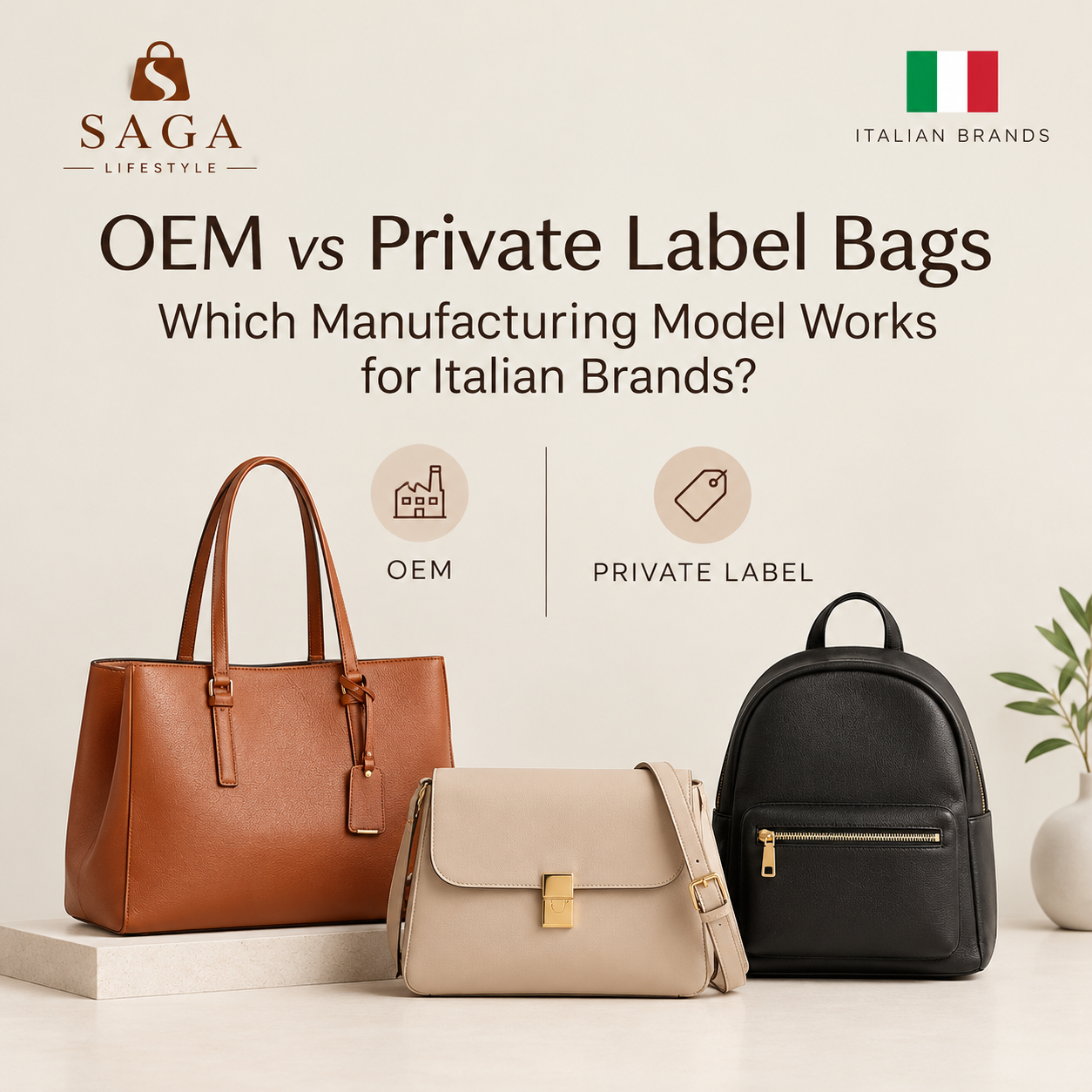
OEM vs Private Label Bags: Which Manufacturing Model Works for Italian Brands?
Introduction
Italian fashion brands, retailers, wholesalers, importers and e-commerce businesses often face an important decision when launching a new bag collection: should they work with an OEM bag manufacturer or choose a private label manufacturing model?
The right choice depends on your product design, branding requirements, customization level, order quantity and long-term business goals. Understanding the difference between OEM and private label bag manufacturing can help Italian businesses choose the right production approach and build a reliable supply chain.
For companies exploring international manufacturing, India offers opportunities to work with manufacturers that produce handbags, tote bags, sling bags, backpacks, laptop bags, duffle bags, shoulder bags, hobo bags and clutches.
Saga Lifestyle is a B2B bag manufacturer based in Bhiwandi near Mumbai, India. Established in 1995, the company manufactures bags using genuine leather, vegan leather, faux leather, rexine and non-leather materials. Its services include OEM bag manufacturing, private label production, custom bag development, sample support and bulk manufacturing for business buyers.
This guide explains OEM vs private label bags, how both models work, which option may suit your Italian business, and how to work with a bag manufacturer in Mumbai for custom products and bulk orders.
What Is OEM Bag Manufacturing?
OEM stands for Original Equipment Manufacturer. In bag manufacturing, OEM production generally means a manufacturer produces bags according to the buyer’s design, technical specifications or agreed product requirements.
The buyer may provide a complete technical pack, drawings, reference samples, measurements or detailed product instructions.
An OEM bag manufacturing project may include:
- Custom handbag designs
- Product dimensions and construction
- Genuine leather or alternative materials
- Colour and finish specifications
- Hardware, zippers and handles
- Linings and compartments
- Logo application and branding
- Product-specific packaging
- Sample development and bulk production
For example, an Italian fashion brand may have its own handbag design and require an Indian manufacturer to produce it according to the approved specifications.
OEM manufacturing can be suitable for businesses that already have a clear product concept and need a manufacturing partner to turn that concept into finished bags.
When searching for an OEM bag manufacturer in Mumbai, buyers should evaluate the manufacturer’s product capabilities, sampling process, production capacity and quality-control procedures before confirming an order.
What Is Private Label Bag Manufacturing?
Private label bag manufacturing allows a business to sell bags under its own brand name while a manufacturer produces the products according to agreed requirements.
Depending on the project, the buyer may choose from an existing product concept, request modifications or develop a more customized design.
Private label manufacturing can cover:
- Handbags
- Tote bags
- Sling and crossbody bags
- Shoulder bags
- Hobo bags
- Clutches
- Backpacks
- Laptop bags
- Duffle and travel bags
Buyers can discuss material selection, colours, dimensions, hardware, logos, labels and packaging according to their brand requirements.
For example, an Italian retailer launching a new fashion label could develop a private label collection featuring leather handbags, vegan leather sling bags and custom tote bags.
The products would be manufactured for the retailer’s brand rather than sold as Saga Lifestyle retail products.
This model can suit Italian fashion brands, independent labels, retailers, wholesalers, importers, distributors and e-commerce businesses seeking to establish their own product identity.
OEM vs Private Label Bags: Key Differences
Both OEM and private label manufacturing can support branded bag collections, but they differ in how the product is defined and developed.
Factor | OEM Bag Manufacturing | Private Label Bag Manufacturing |
Product starting point | Often buyer-provided designs or technical specifications | Existing concepts, customized designs or buyer specifications |
Design control | Based on the agreed technical requirements | Depends on the customization and product agreement |
Branding | Can include buyer branding | Products are sold under the buyer’s brand |
Customization | Often specification-driven | Can range from limited changes to extensive customization |
Sample development | Used to validate the required product | Used to review and approve the selected or customized product |
Typical buyers | Brands with defined product designs | Brands, retailers and businesses developing branded collections |
Production quantities | Agreed according to the project | Agreed according to the project and manufacturer’s MOQ |
The terms OEM and private label are sometimes used differently by individual manufacturers. Buyers should clarify what each supplier includes in its services rather than relying on terminology alone.
Which Manufacturing Model Is Better for Italian Fashion Brands?
There is no single best model for every business. The right option depends on how much product development has already been completed and how much customization the buyer requires.
Choose OEM Manufacturing If You Already Have a Design
OEM manufacturing may be appropriate when your Italian business has:
- Technical drawings or a complete tech pack
- An existing product sample
- Defined dimensions and construction
- Specific material and hardware requirements
- Detailed branding specifications
- A clear production brief
This approach can be useful for established fashion brands that need their designs manufactured according to approved specifications.
Choose Private Label Manufacturing If You Want to Build Your Own Brand
Private label manufacturing may suit your business if you want to launch a branded collection and need a manufacturing partner to discuss product development.
It can be useful for:
- New Italian fashion labels
- Boutique retailers
- Wholesale businesses
- E-commerce brands
- Importers and distributors
- Businesses expanding their existing product range
You may begin with a reference image or product concept and discuss the specifications, materials, branding and sampling process with the manufacturer.
Consider Custom Manufacturing If Your Product Needs More Development
Some projects require a combination of design development and manufacturing.
For example, a brand may have a general idea for a leather shoulder bag but need assistance finalizing its dimensions, compartments, handles, material specifications and construction.
Custom bag manufacturing can provide a route for discussing those requirements before moving into bulk production.
Why Italian Brands Source Bags from India
Italian fashion businesses may consider Indian manufacturers when exploring additional production capacity, different product categories or international sourcing options.
The decision should be based on manufacturing capability and commercial suitability rather than location alone.
Important factors include:
- Product quality and consistency
- Material options
- Product development capabilities
- Sample approval procedures
- Production capacity
- Custom branding
- Bulk-order handling
- Communication and documentation
- Packaging and shipment coordination
An established manufacturing relationship should clearly define product specifications, approval procedures, commercial terms and delivery expectations.
For Italian buyers, working with an Indian manufacturer can also create an opportunity to develop several bag categories through one manufacturing relationship, depending on the supplier’s capabilities.
Bag Manufacturing Services at Saga Lifestyle
Saga Lifestyle works with B2B buyers seeking a bag manufacturing company in Mumbai for OEM, private label, custom and bulk production requirements.
Its manufacturing range includes several categories suitable for fashion, lifestyle, business and retail collections.
Leather Handbags
Custom leather handbags can be developed for Italian fashion brands, boutiques, retailers, wholesalers and private label businesses.
Buyers can discuss bag shape, dimensions, leather specifications, lining, handles, hardware, finishing and logo placement.
Tote Bags
Tote bags can be manufactured for fashion collections, retail businesses, lifestyle brands and corporate requirements.
Sling and Crossbody Bags
Custom sling bags and crossbody bags can be developed in different sizes and configurations for private label collections.
Leather Backpacks
Backpacks can be developed for fashion, lifestyle, business and other commercial applications.
Laptop Bags
Custom laptop bags can be manufactured for corporate buyers, business brands, retailers and private label collections.
Duffle and Travel Bags
Duffle bags and travel bags can be developed for fashion, travel, lifestyle and retail businesses.
Hobo Bags
Hobo bags can be considered for women’s fashion collections and private label handbag ranges.
Shoulder Bags
Custom shoulder bags can be developed according to the buyer’s preferred dimensions, construction, materials and branding requirements.
Clutch Bags
Clutches can be manufactured for fashion collections, boutiques and private label brands.
Saga Lifestyle can also discuss other custom bag requirements based on the buyer’s product specifications.
Material Options for OEM and Private Label Bags
Material selection is an important part of bag manufacturing because it affects the product’s appearance, construction and specifications.
Saga Lifestyle manufactures bags using:
Genuine leather: For buyers specifying genuine leather and their preferred finish, texture and construction.
Vegan leather: For brands seeking vegan leather products, subject to confirmation of the exact material composition and requirements.
Faux leather and rexine: Options for fashion, lifestyle and commercial bag collections, depending on the required specifications.
Non-leather materials: Additional material categories can be discussed according to the product design and intended application.
Italian buyers should specify their material requirements during the quotation and sampling stages. Where relevant, product composition, labelling and applicable European Union requirements should also be confirmed before production.
How the OEM and Private Label Manufacturing Process Works
Whether you choose OEM or private label production, a structured manufacturing process helps align the buyer’s expectations with the finished product.
Step 1: Share Your Product Requirements
Provide your design, technical drawings, reference images or existing sample.
Include the desired dimensions, materials, colour, hardware, lining, branding and estimated order quantity.
Step 2: Discuss Manufacturing Feasibility
The manufacturer reviews the requirements and discusses whether the product can be developed according to the proposed specifications.
Clarify any details that may affect construction, material selection or production.
Step 3: Develop a Sample or Prototype
A sample provides a physical reference for evaluating the product’s appearance, dimensions, materials, construction and finishing.
Saga Lifestyle supports sample and prototype discussions for B2B manufacturing projects.
Step 4: Review and Approve the Sample
The buyer checks the sample against the agreed requirements and communicates any necessary revisions.
The approved sample and specifications can then serve as references for production.
Step 5: Confirm the Commercial Terms
Before bulk production, confirm the quantity, product specifications, pricing, payment terms, production schedule, packaging and shipment responsibilities.
Step 6: Proceed with Bulk Production
Once the order and specifications are confirmed, production can be planned according to the agreed requirements.
Saga Lifestyle has stated manufacturing capacity of approximately 25,000–30,000 bags per month. Actual capacity and lead times should be confirmed for each project.
Step 7: Quality Checking and Shipment Preparation
Finished bags should be checked against the approved specifications, including dimensions, materials, stitching, hardware, branding and finishing.
Products can then be packed according to the agreed requirements and prepared for international shipment.
MOQ and Bulk Bag Orders for Italian Buyers
For businesses sourcing bags commercially, the minimum order quantity is an important factor when selecting a manufacturer.
Saga Lifestyle’s stated MOQ is 500 pieces, subject to confirmation for the particular product and order configuration.
This makes the company’s manufacturing model suitable for discussing B2B requirements rather than individual retail purchases.
Potential bulk-order projects include:
- Private label leather handbags
- OEM tote bags
- Bulk sling bags
- Leather backpacks
- Laptop bags
- Duffle and travel bags
- Hobo bags
- Shoulder bags
- Clutches
- Vegan leather bags
- Faux leather and non-leather bags
Italian buyers should share the required quantity and product mix when requesting a quotation. This helps the manufacturing team understand the scope of the project and discuss the appropriate production approach.
Why Mumbai and Bhiwandi Matter When Choosing a Bag Manufacturer
Saga Lifestyle operates its manufacturing unit in Bhiwandi, Maharashtra, near Mumbai.
Mumbai is a major commercial and logistics centre in India, and the wider region supports manufacturing and industrial activity.
For international businesses searching for a bag manufacturer in Mumbai, leather bag manufacturer in Mumbai or bag manufacturing company in Bhiwandi, location can be one factor in the supplier evaluation process.
However, buyers should also assess product capabilities, sample quality, production capacity, communication and commercial terms.
Saga Lifestyle focuses on manufacturing finished bags. It is not positioned as a general raw-material supplier or a retail bag shop.
This makes the company relevant to businesses seeking an Indian bag manufacturer for private label, OEM and custom bulk-production requirements.
How Italian Businesses Can Import Bags from India
Importing OEM or private label bags from India involves more than selecting a manufacturer.
A typical sourcing workflow is:
Product Brief → Manufacturer Discussion → Sample Development → Sample Approval → Order Confirmation → Bulk Production → Quality Checking → Export Preparation → Shipment to Italy
Before placing an order, Italian businesses should clarify:
- Product specifications and material composition
- Quantity and commercial terms
- Sample approval
- Production and delivery schedules
- Quality requirements
- Branding and packaging
- Freight and insurance responsibilities
- Export documentation
- Italian and EU import requirements
Import duties, product classification and regulatory obligations depend on the specific product and transaction. Buyers should confirm current requirements with their customs broker or freight forwarder.
Clear communication before production helps reduce misunderstandings and supports a more organized sourcing process.
OEM and Private Label Manufacturing for Different Italian Businesses
Italian Fashion Brands
Established brands can use OEM manufacturing for defined product designs or private label manufacturing for branded collections.
Independent Designers
Emerging labels can explore custom handbag development based on product concepts, reference samples or technical drawings.
Boutiques and Retailers
Retailers can discuss private label handbags, totes, shoulder bags and other products for their own collections.
Wholesalers and Importers
Wholesale buyers and importers can discuss commercial quantities, product mixes and manufacturing requirements.
E-commerce Brands
Online businesses can develop branded handbags, sling bags, backpacks, totes and other products for their catalogues.
Distributors
Distributors can explore custom products for their commercial channels and target customers.
How to Choose an OEM or Private Label Bag Manufacturer in India
Before selecting a supplier, Italian buyers should evaluate the following factors.
- Manufacturing experience: Understand the company’s experience with the required product categories.
- Product capabilities: Confirm whether the manufacturer can produce the specific bags you need.
- Material options: Discuss genuine leather, vegan leather, faux leather, rexine or other required materials.
- Sampling: Establish how prototypes are developed, reviewed and approved.
- Branding: Confirm logo placement, labels, hardware and packaging requirements.
- Quality control: Define how production will be checked against the approved specifications.
- Production capacity: Ensure that the supplier can plan for your expected quantity and timeline.
- Commercial clarity: Agree on pricing, payment, delivery, shipping responsibilities and documentation.
- Communication: Ensure that product changes and approvals can be clearly documented throughout the project.
The best manufacturing partner is one whose capabilities, processes and commercial terms match your business requirements.
Frequently Asked Questions
What is the main difference between OEM and private label bags?
OEM manufacturing generally involves producing bags according to a buyer’s designs or technical specifications. Private label manufacturing focuses on products sold under the buyer’s brand. The models can overlap, so the exact scope should be agreed with the manufacturer.
Which model is better for a new Italian fashion brand?
Private label manufacturing may be suitable if you want to launch a branded collection and need to develop products with a manufacturing partner. OEM may be more suitable if you already have detailed designs and specifications.
Can Saga Lifestyle manufacture both OEM and private label bags?
Saga Lifestyle offers B2B bag manufacturing services and can discuss OEM, private label and custom production requirements based on the project specifications.
What types of bags can Saga Lifestyle manufacture?
The product range includes handbags, tote bags, sling bags, backpacks, laptop bags, duffle bags, hobo bags, shoulder bags and clutches.
Does Saga Lifestyle manufacture vegan leather bags?
Yes. Saga Lifestyle manufactures bags using vegan leather as well as genuine leather, faux leather, rexine and non-leather materials, subject to the product requirements.
What is Saga Lifestyle’s minimum order quantity?
Saga Lifestyle’s stated MOQ is 500 pieces. Confirm the applicable quantity for your specific product and order configuration.
Can Italian buyers request samples before bulk production?
Yes. Sample and prototype development can be discussed before bulk manufacturing so buyers can review and approve their products.
Where is Saga Lifestyle located?
Saga Lifestyle’s manufacturing unit is in Bhiwandi, Maharashtra, near Mumbai, India.
Is Saga Lifestyle a raw-material supplier?
No. Saga Lifestyle focuses on manufacturing finished bags according to B2B customer requirements rather than supplying raw materials as a general materials supplier.
Can Saga Lifestyle supply bags to Italian businesses?
Italian businesses can contact Saga Lifestyle to discuss manufacturing requirements, quantities, materials, sampling, branding and international order arrangements. Production and shipping details should be confirmed for each project.
Start Your OEM or Private Label Bag Manufacturing Project
Choosing between OEM and private label manufacturing becomes easier when you define your product design, branding requirements, materials, quantity and commercial goals.
Saga Lifestyle works with B2B buyers seeking a private label bag manufacturer in India, an OEM bag manufacturer in Mumbai or a manufacturing partner for custom and bulk bag production.
Whether your Italian business requires leather handbags, tote bags, sling bags, backpacks, laptop bags, duffle bags, hobo bags, shoulder bags, clutches or vegan leather products, you can start by sharing your product requirements.
To discuss your project, provide:
- Product type and design
- Reference image, technical drawing or existing sample
- Preferred material
- Estimated order quantity
- Logo and branding requirements
- Dimensions and construction details
- Packaging requirements
- Target delivery schedule
These details help the manufacturing team understand your requirements and discuss the next steps.
Contact Saga Lifestyle to discuss custom bag development, sample requirements and bulk manufacturing from Bhiwandi near Mumbai, India.
Recent Post
-
 13 Nov 2026Leather Tote Bag Manufacturing for Italian Retailers & Fashion Brands
-
 23 Oct 2026OEM vs Private Label Bags: Which Manufacturing Model Works for Italian Brands?
-
 13 Oct 2026Private Label Handbag Manufacturing for Italian Fashion Brands: Complete B2B Guide
-
 23 Sep 2026How Italian Brands Can Launch a Private Label Leather Bag Collection with an Indian Manufacturer
-
 18 Sep 2026From Design to Delivery: How UK Brands Can Manufacture Private Label Bags in Bulk
-
 16 Sep 2026How UK Retailers Can Source Custom Leather Bags in Bulk from India
One Response